Knowing What An Existing Structure Can Still Carry
Ageing bridges, load-rating reviews, structures with visible distress, and buildings whose construction records are missing all raise the same question. Cigeotech answers it with measurement rather than opinion.
-
Non-Destructive Survey, Calibrated By Coring
We combine non-destructive testing across the whole structure with targeted destructive verification at representative locations. Core results calibrate the wider survey, producing a defensible picture of in-situ condition and capacity rather than an isolated snapshot.
Condition Assessment
Non-Destructive Testing & Core Verification
We assess highway and rail bridges, culverts and river crossings, multi-storey buildings, industrial floors and frames, water retaining structures, and jetties or marine structures.
Non-Destructive Testing
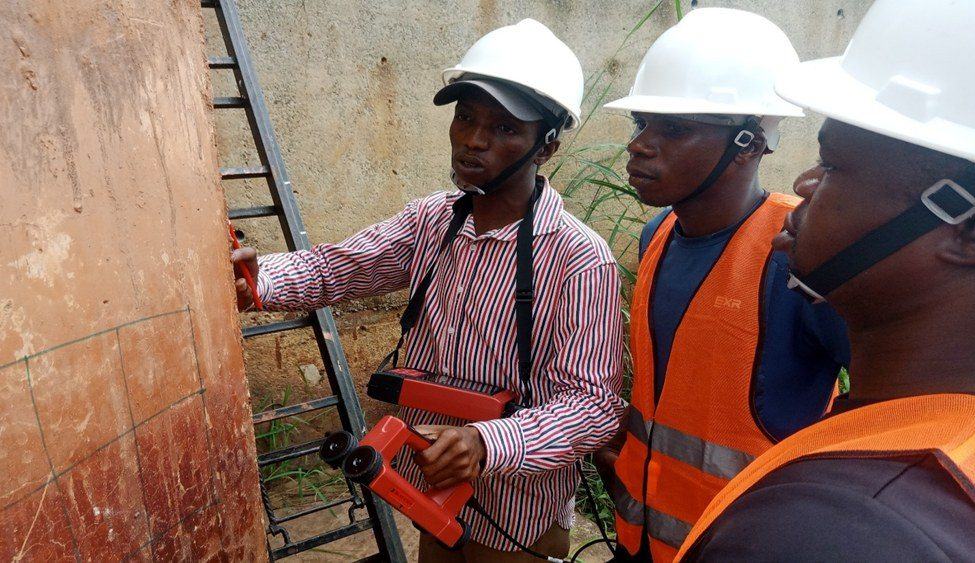
Rebound hammer surface hardness mapping, Ultrasonic Pulse Velocity for internal voids and cracking, covermeter and rebar scanning, half-cell potential survey, and carbonation depth testing.
Core Extraction & Testing
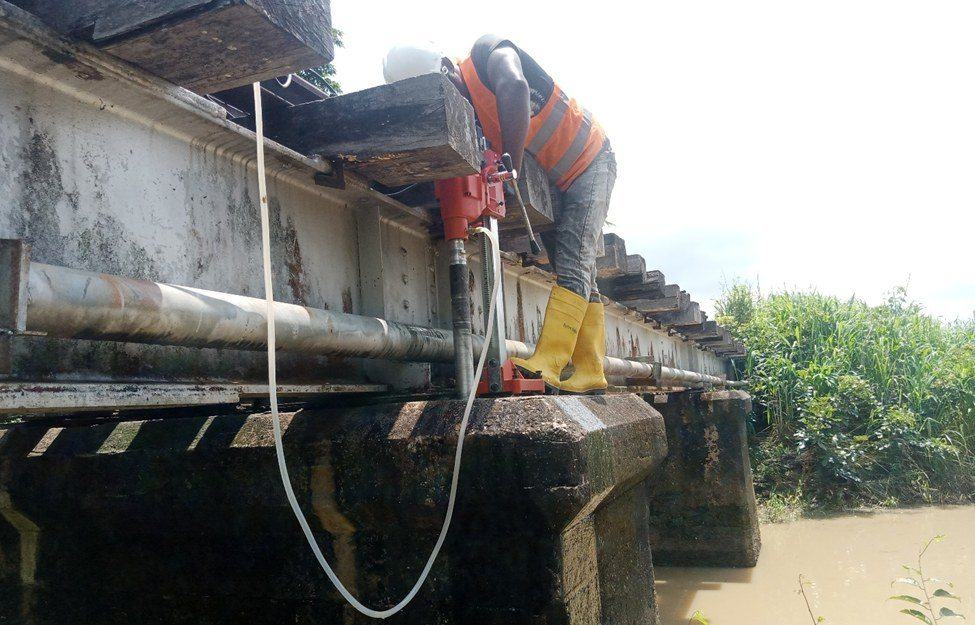
Diamond core extraction from slabs, girders, piers and abutments, compressive strength testing in our laboratory, and chloride and sulphate determination on drilled dust samples.
Condition & Load Rating
Element-by-element condition rating with photographic records, estimated in-situ strength, identified defects with probable cause, and an indicative load assessment against current demand.
Testing Methods
- Rebound hammer (Schmidt hammer) survey
- Ultrasonic Pulse Velocity (UPV) testing
- Covermeter and reinforcement scanning
- Half-cell potential corrosion mapping
- Crack mapping and width measurement
What The Report Delivers
- Element-by-element condition rating
- Estimated in-situ concrete strength
- Defect cause and structural significance
- Indicative load-carrying assessment
- Prioritised remedial recommendations